We've moved.
Need we say more?
Yes, actually. We are waiting for wordpress to come up with a fun importer. Then we shall be exonerate.
Update your links!

Wednesday, January 10, 2007


Thursday, January 04, 2007
Visions
Happy and belated New Year.
I have attempted the arcane business of blogging, but have never seemed to be able to publish anything of sufficient merit and impact these past few weeks. For this I am profoundly unapologetic, in full awareness that at times a blog, as fields of crops, requires an extensive period of lying fallow such that mysterious biological processes may reenergize the soil (by absorbing carcase of small insects, perhaps?) What I have just mentioned is probably nonsense. Blogs cannot lie fallow, or their owners will find that whatever sagging readership they have previously mantained will disappear like autumn leaves come the winter. But when one's ideas are similarly fallow, or if the tender of the crop is otherwise engaged in activities of another nature, then it is inevitable that such things must occur. Therefore I shall acquiscese to the odes of sloth.
Now, come the New Year, I find that once again I have the compulsion to blog. I am unable to imagine why. Several times I have contemplated moving to Wordpress; subject to the apathy of the co-blogger Nova, whom I approached concerning this rather pressing issue, who replied with a random syllable or nine. Doubtless Blogger's all pervasive AI censorship will quail at the mere mention of disloyalty; well, I say to thee, Blogger, if thou wishest to mantain thy devoted slaves, thou wouldst do better to improve thy blog templates.
The question of Blogs comes once again to the forefront of introspection. Why do we blog? Why don't we? Are blogs what they seem, exegeses of expositulary intent, ego-trips, or hopeful attempts to garner notoriety? And why do some blogs lie fallow, why does compulsion, that serpentine monster of caprice, rear and strike at the strangest moments? For you must have known times where you, perhaps, sunk in capitulation to some drudgery or another, are seized with a brilliant snippet of insight that you cannot bear to keep to yourself, but when you finally sit at your computers, fingers poised to deliver your grand expositions, you falter and say, "Mayhap, I, myself, art not of the Temper for the commission of my Thought upon the flimsy paper of the Web." For, myself I must admit that such has happened oftentime, and is partially responsible for the Fallowness of this Blog.
The Fallowness shall probably be a fixture of this Blog for a long time. Perhaps, as the paradox of leisure goes, I shall be compelled to blog more, but somehow I doubt this. But you can never tell when the Blog-muse falls on your shoulders and you have no choice, as the automaton hath, but to sit at your computer and type. I yearn for the days that I could post twice a day. Those days rest, but perhaps I can live them once more, someday. For indeed they are synonymous with the nostalgia-coloured lens of hindsight, that one never fully appreciates the present, but when it is the past. Truly, is nostalgia biased, or are we? Also, was that comment a product of bias? When we perceive the present, do we see with present-tinted cynicism?
In other news I have been reading the Book of the New Sun. It is said to be dense in several ways. It leaves you with an almost indescribable feeling of awe at the sheer imaginative scope and alieness of Severian's society; and yet a feeling of frustration at the inscrutability of the narrative. But then I have not finished, thus comments are reserved for when I do, in the not-so-distant future. I wish, however, that the science fiction tones and settings were more pronounced; versimilitude of the barbarity of this future only goes so far; suspension of disbelief, the fourth wall we keep banging our bodies against when reading a book, is sufficient if spice may be had for the sacrifice of such.
***
I have attempted the arcane business of blogging, but have never seemed to be able to publish anything of sufficient merit and impact these past few weeks. For this I am profoundly unapologetic, in full awareness that at times a blog, as fields of crops, requires an extensive period of lying fallow such that mysterious biological processes may reenergize the soil (by absorbing carcase of small insects, perhaps?) What I have just mentioned is probably nonsense. Blogs cannot lie fallow, or their owners will find that whatever sagging readership they have previously mantained will disappear like autumn leaves come the winter. But when one's ideas are similarly fallow, or if the tender of the crop is otherwise engaged in activities of another nature, then it is inevitable that such things must occur. Therefore I shall acquiscese to the odes of sloth.
Now, come the New Year, I find that once again I have the compulsion to blog. I am unable to imagine why. Several times I have contemplated moving to Wordpress; subject to the apathy of the co-blogger Nova, whom I approached concerning this rather pressing issue, who replied with a random syllable or nine. Doubtless Blogger's all pervasive AI censorship will quail at the mere mention of disloyalty; well, I say to thee, Blogger, if thou wishest to mantain thy devoted slaves, thou wouldst do better to improve thy blog templates.
The question of Blogs comes once again to the forefront of introspection. Why do we blog? Why don't we? Are blogs what they seem, exegeses of expositulary intent, ego-trips, or hopeful attempts to garner notoriety? And why do some blogs lie fallow, why does compulsion, that serpentine monster of caprice, rear and strike at the strangest moments? For you must have known times where you, perhaps, sunk in capitulation to some drudgery or another, are seized with a brilliant snippet of insight that you cannot bear to keep to yourself, but when you finally sit at your computers, fingers poised to deliver your grand expositions, you falter and say, "Mayhap, I, myself, art not of the Temper for the commission of my Thought upon the flimsy paper of the Web." For, myself I must admit that such has happened oftentime, and is partially responsible for the Fallowness of this Blog.
The Fallowness shall probably be a fixture of this Blog for a long time. Perhaps, as the paradox of leisure goes, I shall be compelled to blog more, but somehow I doubt this. But you can never tell when the Blog-muse falls on your shoulders and you have no choice, as the automaton hath, but to sit at your computer and type. I yearn for the days that I could post twice a day. Those days rest, but perhaps I can live them once more, someday. For indeed they are synonymous with the nostalgia-coloured lens of hindsight, that one never fully appreciates the present, but when it is the past. Truly, is nostalgia biased, or are we? Also, was that comment a product of bias? When we perceive the present, do we see with present-tinted cynicism?
In other news I have been reading the Book of the New Sun. It is said to be dense in several ways. It leaves you with an almost indescribable feeling of awe at the sheer imaginative scope and alieness of Severian's society; and yet a feeling of frustration at the inscrutability of the narrative. But then I have not finished, thus comments are reserved for when I do, in the not-so-distant future. I wish, however, that the science fiction tones and settings were more pronounced; versimilitude of the barbarity of this future only goes so far; suspension of disbelief, the fourth wall we keep banging our bodies against when reading a book, is sufficient if spice may be had for the sacrifice of such.
***
Saturday, December 09, 2006
Japan
is a very interesting place. I’ve been here for about five days, and am currently at Narita eating at the same café where collinear and I rushed to fill out our OM style and prop forms, which we were actually supposed to do a week before. Their menu has changed somewhat though; instead of beef stew and pizza like the last time, I’m currently having curry and naan. Which reminds me of our OM Karan jokes: Together we can make beautiful chapatti! Ask any omer for details.
Anyhow: quite frankly, I’ve always disliked the whole Wapanese, or pseudo-Japanese, culture that seems to have sprung out everywhere with a tv and access to Naruto. Seriously, nothing boils the blood quite like a bevy of 16 year old pimpled white teens/ah lians with yellow hair and ultra high boots doing a “Kawaiii neee!, or having a conversation with someone who adds the suffix “-San” to the end of your name about twenty times in a row in order to sound like a four year old Japanese boy. Thankfully, the real thing is far, far better.
I started the trip at Club Med Sapporo.
First, lets start with a quick check: do YOU know where Club Med Sapporo is?
Well yes, aside from being in Sapporo.
No?
Good, thought so.
Unfortunately though, for some unfathomable reason, even though it takes a 7 hour plane ride, two 2 hour train rides and THEN a 30 minute bus ride to get there, the place was SWARMING with Singaporeans. Not just any Singaporeans too; Acsians. They even outnumbered the Japanese! As a result, almost every conversation in the next three days began with “HEY YOU! Class of 7_ right?! Do you know [string of entirely random names]? My son’s from ACS too, is yours?” and so on. I can almost see US doing it thirty years down the road…the Class of 08, hah. Doesn’t quite sound the same.
The huge AC crowd did have its benefits though. I met a few people from our school, most notably Josh (not Hoe, the Indian one) from sec 3 GEP and OM. We spent many memorable moments falling down spectacularly from the steepest hills we could get our hands (or rather, feet) on, accosting the hill with our skiis and snowboards. Unfortunately, because the ski lifts weren’t open yet, we had to pound our own ski slope by packing the soft snow with our skiis, a task which left muscles we never knew existed burning. Consequently, I am now well prepared for a subsequent life as an ox or miscellaneous farm animal.
Club Med has always been a bucketful of fun because of three things:
1) Really interesting people
2) Very challenging activities you wont normally do
and
3) Terrific food.
I must say, Club Med Sapporo hits all three counts square on with a large sledgehammer, and if you ever want a holiday experience that doesn’t involve seeing Shinto Shrine after Shinto Shrine, I highly recommend it. For your sake though, don’t go during the Singaporean school holidays.
After Club Med, I went to Tokyo. Here I witnessed the full spectacle of Japanese fashion: everyone fell into three broad categories – Over-Fifty, Goth, and Hobo. I saw a man with more holes in his jeans than there was denim, wearing a cap with four different colours, and a shirt that had some badly mangled English idiom with “Sex!” written in purple all over it. I figured that the only way anyone could possibly outdo the Japanese tendency toward outrageous clothing is if they wore pajamas. Which, naturally, is what I did. I walked around Harajuku, the trendiest teeny-popper area, dressed in my OM green pajamas (with thermals underneath, naturally, because it was 2 degrees Celcius). It was fun, and several passerbys actually thought it was a good idea for an outfit. Hah.
There are several things about Japan that I admire, chief of which is their architecture. Tokyo doesn’t have the gigantomania of Dubai or Hongkong. It doesn’t have terribly tall buildings, and the famous Tokyo Tower is just a mundane radio broadcasting station. Yet, there’s something inexplicably quaint about the way a Japanese building looks, a something which a HDB block, for example, glaringly lacks. When you step into a Japanese room, it may not use the most expensive Italian marble, nor have huge neo-classical columns, but it looks and feels good. Using simple wood, concrete and neutral colors, they somehow manage to create an environment that is both comfortable and elegant at the same time. It’s rare that one sees this kind of understated beauty anywhere else.
Second of all, I love their obsession with perfection. The food tastes good again not because they cook it in any special way, but because they obsess over every last detail of the ingredients, from the fineness of the flour to the temperature at which they store the sashimi. The ski slopes were closed when I went because there was a tiny patch of grass visible at one section of the slope. Their contraptions, such as the toilet with more buttons than a stealth bomber, to quote The Sims, are almost comical in their huge range of functions.
Thirdly, the weather is amazing, although probably not through any effort by the Japanese unless someone really invented one of those Gundam climate control things. I swear, there’s something in the air that makes everyone look young. In Club Med, for example, I met a Japanese guy who could have passed for a seventeen year old back home, only to find out that he was twenty nine and married.
Last of all, I am amazed by their civic-mindedness, for lack of a better word. One of the most striking things I saw was when a Japanese man took a drink from the dispenser in an airline lounge where I was and spilled a few drops. He spent the next ten minutes searching for a napkin, meticulously wiping the table where the spill was, which by then had already evaporated for the most part, and then walking around to search for a recycling bin for the paper even though there was a trashbin right in front of him.
Naturally, there is probably a much darker side to all of this that a casual tourist such as myself will never see. A problem that is rather apparent, however, is the almost derogatory portrayal of women. You know there is something amiss when even the parking ticket dispenser has a cartoon teenage girl dressed in a sailor uniform and a very short skirt bowing to you repeatedly on the touchscreen.
Secondly, the way everyone seems to be excessively polite, women especially, seems to have led to the loss of significance of courtesy, with most people ignoring you when you say excuse me or please. They need an Un-Courteous Lion.
Finally, it seemed to me as if they placed undue importance on appearances; while roaming Harajuku in pajamas, I realized that there were only two kinds of shops: those that sold NOTHING but four floors of cosmetics, and those that sold four floors of Lolita and Gothic clothing. It was ridiculous. A sizeable percentage of the women I walked past along the street wore enough makeup to paint several houses, with outfits so extravagant they leave you wondering how much time was spent assembling them.
Nevertheless, I must say that I have had a good time. In fact, some things reminded me of events in Foundation, that fantastic book by my favourite author that our dear friend Collinear so graciously spoiled for me so many years ago. The double decker subway train with seats on top that required passes, for one. Also, I was reminded of a comment by a settler in some new colony in a distant part of Asimov’s galaxy, envying the culture and history of the Earthlings. Being in Japan made me wonder what it must be like to stem from, and be bound by, traditions and etiquette thousands of years old. It made me wonder what it would be like to grow up in a place which hundreds of generations of my forebears toiled to build, and in which everything has been done before. Maybe it explains why all the artsy Japanese films seem to reveal some kind of profound loneliness and frustration with life in general. Ah well; that’s yet another story, for yet another day.
The plane’s about to take off and the stewardess is saying something incomprehensible in Japanese that probably means she’s going to throw my preciousss BlackBook out of the window if I don’t go. Muchos homework awaits my return, and I currently face the prospect of spending my 17th birthday in a military facility in Sichuan, trying to explain the Theory of Conservation of Energy and geosynchronous orbit in traditional Chinese.
Exciting.
Anyhow: quite frankly, I’ve always disliked the whole Wapanese, or pseudo-Japanese, culture that seems to have sprung out everywhere with a tv and access to Naruto. Seriously, nothing boils the blood quite like a bevy of 16 year old pimpled white teens/ah lians with yellow hair and ultra high boots doing a “Kawaiii neee!, or having a conversation with someone who adds the suffix “-San” to the end of your name about twenty times in a row in order to sound like a four year old Japanese boy. Thankfully, the real thing is far, far better.
I started the trip at Club Med Sapporo.
First, lets start with a quick check: do YOU know where Club Med Sapporo is?
Well yes, aside from being in Sapporo.
No?
Good, thought so.
Unfortunately though, for some unfathomable reason, even though it takes a 7 hour plane ride, two 2 hour train rides and THEN a 30 minute bus ride to get there, the place was SWARMING with Singaporeans. Not just any Singaporeans too; Acsians. They even outnumbered the Japanese! As a result, almost every conversation in the next three days began with “HEY YOU! Class of 7_ right?! Do you know [string of entirely random names]? My son’s from ACS too, is yours?” and so on. I can almost see US doing it thirty years down the road…the Class of 08, hah. Doesn’t quite sound the same.
The huge AC crowd did have its benefits though. I met a few people from our school, most notably Josh (not Hoe, the Indian one) from sec 3 GEP and OM. We spent many memorable moments falling down spectacularly from the steepest hills we could get our hands (or rather, feet) on, accosting the hill with our skiis and snowboards. Unfortunately, because the ski lifts weren’t open yet, we had to pound our own ski slope by packing the soft snow with our skiis, a task which left muscles we never knew existed burning. Consequently, I am now well prepared for a subsequent life as an ox or miscellaneous farm animal.
Club Med has always been a bucketful of fun because of three things:
1) Really interesting people
2) Very challenging activities you wont normally do
and
3) Terrific food.
I must say, Club Med Sapporo hits all three counts square on with a large sledgehammer, and if you ever want a holiday experience that doesn’t involve seeing Shinto Shrine after Shinto Shrine, I highly recommend it. For your sake though, don’t go during the Singaporean school holidays.
After Club Med, I went to Tokyo. Here I witnessed the full spectacle of Japanese fashion: everyone fell into three broad categories – Over-Fifty, Goth, and Hobo. I saw a man with more holes in his jeans than there was denim, wearing a cap with four different colours, and a shirt that had some badly mangled English idiom with “Sex!” written in purple all over it. I figured that the only way anyone could possibly outdo the Japanese tendency toward outrageous clothing is if they wore pajamas. Which, naturally, is what I did. I walked around Harajuku, the trendiest teeny-popper area, dressed in my OM green pajamas (with thermals underneath, naturally, because it was 2 degrees Celcius). It was fun, and several passerbys actually thought it was a good idea for an outfit. Hah.
There are several things about Japan that I admire, chief of which is their architecture. Tokyo doesn’t have the gigantomania of Dubai or Hongkong. It doesn’t have terribly tall buildings, and the famous Tokyo Tower is just a mundane radio broadcasting station. Yet, there’s something inexplicably quaint about the way a Japanese building looks, a something which a HDB block, for example, glaringly lacks. When you step into a Japanese room, it may not use the most expensive Italian marble, nor have huge neo-classical columns, but it looks and feels good. Using simple wood, concrete and neutral colors, they somehow manage to create an environment that is both comfortable and elegant at the same time. It’s rare that one sees this kind of understated beauty anywhere else.
Second of all, I love their obsession with perfection. The food tastes good again not because they cook it in any special way, but because they obsess over every last detail of the ingredients, from the fineness of the flour to the temperature at which they store the sashimi. The ski slopes were closed when I went because there was a tiny patch of grass visible at one section of the slope. Their contraptions, such as the toilet with more buttons than a stealth bomber, to quote The Sims, are almost comical in their huge range of functions.
Thirdly, the weather is amazing, although probably not through any effort by the Japanese unless someone really invented one of those Gundam climate control things. I swear, there’s something in the air that makes everyone look young. In Club Med, for example, I met a Japanese guy who could have passed for a seventeen year old back home, only to find out that he was twenty nine and married.
Last of all, I am amazed by their civic-mindedness, for lack of a better word. One of the most striking things I saw was when a Japanese man took a drink from the dispenser in an airline lounge where I was and spilled a few drops. He spent the next ten minutes searching for a napkin, meticulously wiping the table where the spill was, which by then had already evaporated for the most part, and then walking around to search for a recycling bin for the paper even though there was a trashbin right in front of him.
Naturally, there is probably a much darker side to all of this that a casual tourist such as myself will never see. A problem that is rather apparent, however, is the almost derogatory portrayal of women. You know there is something amiss when even the parking ticket dispenser has a cartoon teenage girl dressed in a sailor uniform and a very short skirt bowing to you repeatedly on the touchscreen.
Secondly, the way everyone seems to be excessively polite, women especially, seems to have led to the loss of significance of courtesy, with most people ignoring you when you say excuse me or please. They need an Un-Courteous Lion.
Finally, it seemed to me as if they placed undue importance on appearances; while roaming Harajuku in pajamas, I realized that there were only two kinds of shops: those that sold NOTHING but four floors of cosmetics, and those that sold four floors of Lolita and Gothic clothing. It was ridiculous. A sizeable percentage of the women I walked past along the street wore enough makeup to paint several houses, with outfits so extravagant they leave you wondering how much time was spent assembling them.
Nevertheless, I must say that I have had a good time. In fact, some things reminded me of events in Foundation, that fantastic book by my favourite author that our dear friend Collinear so graciously spoiled for me so many years ago. The double decker subway train with seats on top that required passes, for one. Also, I was reminded of a comment by a settler in some new colony in a distant part of Asimov’s galaxy, envying the culture and history of the Earthlings. Being in Japan made me wonder what it must be like to stem from, and be bound by, traditions and etiquette thousands of years old. It made me wonder what it would be like to grow up in a place which hundreds of generations of my forebears toiled to build, and in which everything has been done before. Maybe it explains why all the artsy Japanese films seem to reveal some kind of profound loneliness and frustration with life in general. Ah well; that’s yet another story, for yet another day.
The plane’s about to take off and the stewardess is saying something incomprehensible in Japanese that probably means she’s going to throw my preciousss BlackBook out of the window if I don’t go. Muchos homework awaits my return, and I currently face the prospect of spending my 17th birthday in a military facility in Sichuan, trying to explain the Theory of Conservation of Energy and geosynchronous orbit in traditional Chinese.
Exciting.
Thursday, November 30, 2006
A Preponderance of Literature and Rants
I cannot for the life of me imagine why I read Pride and Prejudice. It is similar to reading Susanna Clarke after taking barbiturates, and without any magic whatsoever. (The reverse would have been much more appropriate, but I'm afraid sff has consumed my mind). The book is a whimsical exercise of extravagant manners and bursting with faint cries of approbation and frilly hats. Still, it is by no means an uninteresting book. Perhaps that is what makes it such an enduring classic.
Today I bought Peace and War, the Joe Haldeman omnibus consisting of all his Forever books (whatever). It is a most lovely book, with lovely red borders. I also borrowed The Book of the New Sun, after an abortive attempt at the NLB to scrounge for more Zelazny-related information. They, too, are most lovely books, and it pains me that I shall have to return them one day, especially as I am much convinced that I shall be liking these novels very much indeed, and I would be most miserable if they were not mine to reread whenever I wished. I have also The First Chronicles of Amber, which I purchased just before I came across a pristine copy of the Great Book of Amber in a second hand bookstore, an oversight for which I am greviously upset.
In an amazing stroke of fortune, I have come across three lovely bookstores at Vivocity and Orchard; PageOne, San, and Harris in Orchard MRT, and I expect I shall be patronizing them very often indeed.
***
V for Vendetta is an great movie in terms of plot and execution. The message was not as well-constructed as I expected. It is a rather formulaic tale about dystopia made spicy with the inclusion of the figure of V, whose introductory speech I have memorized. Still, I can't tell whether he is supposed to be a bomb-throwing anarchist or freedom fighter, and I am inclined to believe the latter, under the circumstances. V for Vendetta has lovely pacing and cinematography; the bombing of the Bailey sent shivers down my spine. The symbolism is rather shallow, especially the fetish on V and 5, but that's alright; it's a rather smart acknowledgement of historical events and a rambunctious character idiosyncrasy Moore and the directors after him could exploit for weirdness. In any case, a great, but not revolutionary, movie, for all the revolutionary claptrap it depicts, like blowing up Parliament - what barbaric splendor mixed up against terrible echoes of recent history, a heady but vaguely shocking dichotomy.
***
I must say I despise reviews that go, "This genre would be doomed if not for so-and-so, whose work has rescued the genre". It seems to me to be quite a dangerous, polemical, and unfairly critical statement that borders on exaggeration. Blase and jaded the professional reviewer may be, it is not up to his bibliomanic sensibilities to measure the worth of a book; if it is conventional yet well crafted and entertaining, and conveys its message arcoss effectively, then its a good book. No need to be groundbreaking or creative to make a work good. LOTR is by today's standards cliche; that does not make it unworthy of reading.
***
Saw EVIL FOR EVIL today in Kinokuniya, the middle book in the Engineer Trilogy by KJ Parker. I'll have to wait until the trade paperback is published. Curse these publishers! And their large pricetags. And their big, bulky novels. Pah.
R Scott Bakker's The Thousandfold Thought
Scott Lynch's Lies of Locke Lamora
Aaron Allston's Betrayal
Steven Erikson's Bonehunters
These are a few books that have been denied me by virtue of their hardbackedness or tradepaperbackish vibes. The Mass Market Paperback is an object of immense beauty. After all that has passed, it is beauty.
The first Golden Compass pictures have been released. Daniel Craig as Asriel. How...amazing of him.
***
Today I bought Peace and War, the Joe Haldeman omnibus consisting of all his Forever books (whatever). It is a most lovely book, with lovely red borders. I also borrowed The Book of the New Sun, after an abortive attempt at the NLB to scrounge for more Zelazny-related information. They, too, are most lovely books, and it pains me that I shall have to return them one day, especially as I am much convinced that I shall be liking these novels very much indeed, and I would be most miserable if they were not mine to reread whenever I wished. I have also The First Chronicles of Amber, which I purchased just before I came across a pristine copy of the Great Book of Amber in a second hand bookstore, an oversight for which I am greviously upset.
In an amazing stroke of fortune, I have come across three lovely bookstores at Vivocity and Orchard; PageOne, San, and Harris in Orchard MRT, and I expect I shall be patronizing them very often indeed.
***
V for Vendetta is an great movie in terms of plot and execution. The message was not as well-constructed as I expected. It is a rather formulaic tale about dystopia made spicy with the inclusion of the figure of V, whose introductory speech I have memorized. Still, I can't tell whether he is supposed to be a bomb-throwing anarchist or freedom fighter, and I am inclined to believe the latter, under the circumstances. V for Vendetta has lovely pacing and cinematography; the bombing of the Bailey sent shivers down my spine. The symbolism is rather shallow, especially the fetish on V and 5, but that's alright; it's a rather smart acknowledgement of historical events and a rambunctious character idiosyncrasy Moore and the directors after him could exploit for weirdness. In any case, a great, but not revolutionary, movie, for all the revolutionary claptrap it depicts, like blowing up Parliament - what barbaric splendor mixed up against terrible echoes of recent history, a heady but vaguely shocking dichotomy.
***
I must say I despise reviews that go, "This genre would be doomed if not for so-and-so, whose work has rescued the genre". It seems to me to be quite a dangerous, polemical, and unfairly critical statement that borders on exaggeration. Blase and jaded the professional reviewer may be, it is not up to his bibliomanic sensibilities to measure the worth of a book; if it is conventional yet well crafted and entertaining, and conveys its message arcoss effectively, then its a good book. No need to be groundbreaking or creative to make a work good. LOTR is by today's standards cliche; that does not make it unworthy of reading.
***
Saw EVIL FOR EVIL today in Kinokuniya, the middle book in the Engineer Trilogy by KJ Parker. I'll have to wait until the trade paperback is published. Curse these publishers! And their large pricetags. And their big, bulky novels. Pah.
R Scott Bakker's The Thousandfold Thought
Scott Lynch's Lies of Locke Lamora
Aaron Allston's Betrayal
Steven Erikson's Bonehunters
These are a few books that have been denied me by virtue of their hardbackedness or tradepaperbackish vibes. The Mass Market Paperback is an object of immense beauty. After all that has passed, it is beauty.
The first Golden Compass pictures have been released. Daniel Craig as Asriel. How...amazing of him.
***
Monday, November 27, 2006
Crimson Flame
Tell
The monster resembled a giant lizard. It stormed through the city, breathing flame and burning thousands. Its huge claws picked people off the street and threw them into its colossal jaws. Its muscular legs toppled smaller buildings as it continued its dreadful march through the crowded city center.
Show
The terrible fire lizard towered over the streets of the doomed city. Men and women scattered, screaming, before the great monster's inexorable approach. It opened its cavernous jaws and breathed forth an immense gout of blinding crimson flame. The dreadful conflagaration scorched the asphalt, gouging and crisping the hardened tarmac. One man, not fast enough, was caught in the terrible path of flame and burnt like a torch, screaming in purest agony. But worse was to come. The massive bulk of the creature bore down on the streets. Its claws flexed and clenched, grasping one woman like a vise. Her helpless screams did not avail her. The monster, ravenous, brought his prize catch up to his massive jaws and consumed the woman with a snap of those powerful muscles. Satiated, it roared a stentorian evocation of satisfaction, shaking the metropolis to the core; then it extended a huge, muscle strained leg and, with all its might, struck an old building with blinding speed. The structure collapsed in a damning crescendo of terrible noise of falling men. The dust cloud was infernal. Satisfied, the monster lumbered triumphantly on.
Purple
Only the Titans in their halcyon days could have availed the doomed city, its terrible fate having been foreordained by the tragic circumstance of inevitability. The scudding clouds dotting the empyrean above provided a stark counterpoint as the monstrous abomination ravaged the shaded avenues of the once splendid downtown. Hither did it approach on reptilian legs, its coming the dilatoriness of one who is aware of the inexorability of its terrible, absolute domination. The grand play of circumstance was thus begun, as the dread monster elected to release Hell itself in the form of a great, sweeping crimson cataclysm on the hapless populace, fleeing in blinded horror and panic. The molten heat of the consuming inferno scorched the veritable essence of the thirsting ground, sending up great bouts of smoke, black as the darkest shadow. The imitable torch caught an unfortunate soul in its fiery clutches, electing to consume him in a burst of ravenous flames. The mammoth beast was the instrument of blind desire. Its ravenous hunger now dominated its attention. Bending its considerable bulk, it thus reached down to clutch a woman in its vise-like grip. Slowly, the onrush of anticipation, unaffected by the woman's screams, bore down on it, and casually he tossed his impending snack into his jaws, a world of darkness and agony in the ribbed innards of the furnace of being. Roaring its saturnine satisfaction it reached out a leg and unleashed his murderous power onto the nearest structure. The hapless building held for a moment, then collapsed in a vast symphony of dust and death, the screams of those inside echoing the melody of Fate. Its aggression vented on a victim, it trod on, victorious but uncaring of the role that Fate had provided him.
Abstract
World of heat, sensation of restraint undeveloped, need and want blurred into unified symphony with the will - alien. Alienness. Assailed of speculative hunger and wanton devastation of artifical agony. Therefore the horrors, whence the crimson light of destruction. It burns and is satisfied. It its and is revenged. It unleashes strength in all its simplistic harmony, strength against cowardice, and turns, desiring to be sated to be hungered to be sated to be -
The monster resembled a giant lizard. It stormed through the city, breathing flame and burning thousands. Its huge claws picked people off the street and threw them into its colossal jaws. Its muscular legs toppled smaller buildings as it continued its dreadful march through the crowded city center.
Show
The terrible fire lizard towered over the streets of the doomed city. Men and women scattered, screaming, before the great monster's inexorable approach. It opened its cavernous jaws and breathed forth an immense gout of blinding crimson flame. The dreadful conflagaration scorched the asphalt, gouging and crisping the hardened tarmac. One man, not fast enough, was caught in the terrible path of flame and burnt like a torch, screaming in purest agony. But worse was to come. The massive bulk of the creature bore down on the streets. Its claws flexed and clenched, grasping one woman like a vise. Her helpless screams did not avail her. The monster, ravenous, brought his prize catch up to his massive jaws and consumed the woman with a snap of those powerful muscles. Satiated, it roared a stentorian evocation of satisfaction, shaking the metropolis to the core; then it extended a huge, muscle strained leg and, with all its might, struck an old building with blinding speed. The structure collapsed in a damning crescendo of terrible noise of falling men. The dust cloud was infernal. Satisfied, the monster lumbered triumphantly on.
Purple
Only the Titans in their halcyon days could have availed the doomed city, its terrible fate having been foreordained by the tragic circumstance of inevitability. The scudding clouds dotting the empyrean above provided a stark counterpoint as the monstrous abomination ravaged the shaded avenues of the once splendid downtown. Hither did it approach on reptilian legs, its coming the dilatoriness of one who is aware of the inexorability of its terrible, absolute domination. The grand play of circumstance was thus begun, as the dread monster elected to release Hell itself in the form of a great, sweeping crimson cataclysm on the hapless populace, fleeing in blinded horror and panic. The molten heat of the consuming inferno scorched the veritable essence of the thirsting ground, sending up great bouts of smoke, black as the darkest shadow. The imitable torch caught an unfortunate soul in its fiery clutches, electing to consume him in a burst of ravenous flames. The mammoth beast was the instrument of blind desire. Its ravenous hunger now dominated its attention. Bending its considerable bulk, it thus reached down to clutch a woman in its vise-like grip. Slowly, the onrush of anticipation, unaffected by the woman's screams, bore down on it, and casually he tossed his impending snack into his jaws, a world of darkness and agony in the ribbed innards of the furnace of being. Roaring its saturnine satisfaction it reached out a leg and unleashed his murderous power onto the nearest structure. The hapless building held for a moment, then collapsed in a vast symphony of dust and death, the screams of those inside echoing the melody of Fate. Its aggression vented on a victim, it trod on, victorious but uncaring of the role that Fate had provided him.
Abstract
World of heat, sensation of restraint undeveloped, need and want blurred into unified symphony with the will - alien. Alienness. Assailed of speculative hunger and wanton devastation of artifical agony. Therefore the horrors, whence the crimson light of destruction. It burns and is satisfied. It its and is revenged. It unleashes strength in all its simplistic harmony, strength against cowardice, and turns, desiring to be sated to be hungered to be sated to be -
Tuesday, November 21, 2006
Extremities
Literature provokes a response. Great literature speaks to a reader to the depths of his soul. The response of the reader is not essentially what the writer may intend; as long as the reader gains something from the work, or has been affected by the novel, the writer is uplifted. Few books have elicted a powerful response in me; the primal quality of such books, however, is that which reaches into the innermost sanctums of feeling and resides there. And when I think of these novels, a powerful sensation will invariably course through me. Below is a list.
1. Watership Down
Watership Down is the defining novel of my childhood; it has a beauty and power I have yet to experience anywhere else, of camaraderie, sacrifice, pain and passion. The writing is modern yet graceful, erudite yet accessible, and communicates every nuance of what Adams wanted the reader to sense. No other writer could take a group of animals and craft them such that they seem more human than the humans in the novel, and yet so animalistic in their society and culture. No other writer could so gracefully weave the rudiments of a completely alien society into a grouping of rabbits so mundane and prosaic in their thinking. Setting and plot are transformed from the rabbit's perspective; the peaceful English countryside is transformed into a tantalizingly mystical land of oppurtunity and danger in their eyes. The descriptions are haunting, evocative and powerful. There is even a touch of gentle humour that keeps the novel engaging even in the most serious of moments. Watership Down is truly a novel that spoke to me, and left an indelible mark on my mind.
2. Lord of the Rings
Strangely enough, the first time I read Tolkien's work, I found the latter portions boring. I liked the pastoral nature of Hobbitry and the mystery of the Barrow Downs, the terrible darkness of Moria, and the sheer loveliness of Rivendell. Aragon's adventures held little excitement for me. The second time, everything changed. Lord of the Rings was transformed into the seminal epic fantasy. Never before had I ever experienced the full scope and power of the novel as in Lord of the Rings, the epic feel, the immersion and sheer complexity and history of Middle Earth. Lord of the Rings didn't appeal to me because of its compassion and humanity, but because of the grandness, density of plotting, excitement, and above all the sheer believability of Middle Earth. Lord of the Rings introduced me to fantasy. It remains one of the greatest books of fantasy written.
3. Harry Potter
Believe it or not, Nova introduced me to this in secondary 4. For the longest time, I resisted this, based on vague notions of incipient YA nubness. I was wrong. Harry Potter is the penultimate escapist work (the ultimate being Star Wars) of the century; it evokes a yearning in the reader to be there, to join in the fun, to know what it is like to be a Hogwart's student. It is truly a book that is accessible to all age groups. Its appeal is universal and undeniable. It invoked in me the old sense of wonder. It emphasizes the importance of love and friendship. It resonated with its sympathetic portraits of school. It became a refuge, a haven from the bitter reality of the world, and as such highlights the reason why Harry Potter is so popular. Its a salve for a bruised spirit and a drug for stress; its curious blend of maturity and innocence is heady and speaks to the reader. This is one series finely conceived, lovingly treated, carefully sustained, and is arguably one of the greatest YA fiction series ever written.
4. His Dark Materials
While Pullman may be abit of a hypocrite with regards to Narnia, his books combine elements of both Potter and Narnia. That is the intimacy and sense of wonder invoked in Harry Potter with the epic scope and religosity of philosophy in Narnia. It is the anti-Narnia, the philosophical counter, but in its way it is just as great. The idea of daemons is truly compellng. I almost wished I had one when I first read Northern Lights. This series has a heartwrenchingly beautiful premise and a heartrendingly shattering ending.
5. Star Wars
The premise of Star Wars is that of an amalgamation of Grade-B Flash Gordon and simple yet powerful story in terms of plot, setting and message. Star Wars spoke to me because of its exotic locales, fantastic premise, special effects, and the compelling dynamics of the characters, as well as its simple but effective message of redemption, goodwill, courage and heroism. The prequels were not technically as brilliant, but TPM spoke to me in terms of its childlikeness and sheer cinematic elegance, while the other two prequels really gave me a sense of the crippling malaise that is corruption and a suggestion of the sheer horrific magnificience of a dying empire. The prequels, by stressing the decay of the Republic, spoke to me of the need for renewal. It is a grand, epic cycle of history. When one brings in the whole regalia of associated material, the books, games, comics etc, Star Wars transcends its mythos and becomes a true sandbox of the imagination and the greatest and most completely conceived fictional universe around, without question.
6. Robot Series
The Robot series, especially the latter two books, are some of the most powerful, moving books Asimov ever wrote, including Prelude to Foundation and Foward the Foundation, and shows Asimov at his best writing about characters. He made me care for Elijah Baley; I felt the sadness at the passing of a great historical figure at Baley's death. It's amazing how he chronicled Daneel's slow evolution towards his ultimate role, and the friendship between Giskard and him. Although the science fiction ideas are a little outmoded, Asimov writes with great power and clarity, and the strength of his prose and the wit, compassion and humour in the plot are truly indicators that Asimov was a true master at his profession. It is the primer for the epic Foundation series, that other great (but not nearly as moving) work, a great part of that grand cycle of future history that stands as another one of the greatest conceived science fiction universes ever made.
7. Terraforming Earth
Jack Williamson's novel about a group of clones who constantly reseed Earth after it suffers catastrophies is one of the most profound and compassionate post-apocalyptic books ever written. Normally, I don't like post-apocalyptic works, but Terraforming Earth was superb in its treatment. The book is intimately recounted from the perspective of the historian of the group; Earth's presumed saviours are fleshed out and realized, the plot is evocative, tragic, and beautiful, and the various civilizations that arise out of the clone's reseeding missions are interesting and original. The book's message of resilience amidst our incipient frailties resounds through the work, setting it in a light that adds to, rather than subtracts from, from its tragic element. Truly one of the best post-apocalypse science fiction novels yet written.
On the flip side, there are works that have inspired a negative reaction from me. I read them and despised them. Or, I disagreed vehemently with them. I'm not saying that these novels are bad, but that I disliked the messages within; they resounded in me and I decided that I didn't like the music. Below is a list.
1. Childhood's End
Deeply unsettling and pessimistic novel about how we have reached the end of our history and how a new species of human will inevitably take over and serve the universe. The seminal posthumanity novel, deeply disturbing in its premise.
2. Time
Another one of those posthuman novels, Stephen Baxter suggests that since the human race is doomed to extinction during the Cosmic Whimper, humanity should be snuffed out to create more universes in order to give rise to other life. Deeply fatalistic and unsettling.
3. Night's Dawn Trilogy
I liked this trilogy, but one aspect of it ruined the experience. The sheer volume of perverse, graphic iniquity is very shocking to the reader, and detracts from the plot. Hamilton would have done better to tone the sex down, by a notch or six. Yes, indeed. And the Deus ex machina wasn't that good either, Mt Hamilton.
Alright. That wraps it up. We should start a thread on CAPERS for such.
1. Watership Down
Watership Down is the defining novel of my childhood; it has a beauty and power I have yet to experience anywhere else, of camaraderie, sacrifice, pain and passion. The writing is modern yet graceful, erudite yet accessible, and communicates every nuance of what Adams wanted the reader to sense. No other writer could take a group of animals and craft them such that they seem more human than the humans in the novel, and yet so animalistic in their society and culture. No other writer could so gracefully weave the rudiments of a completely alien society into a grouping of rabbits so mundane and prosaic in their thinking. Setting and plot are transformed from the rabbit's perspective; the peaceful English countryside is transformed into a tantalizingly mystical land of oppurtunity and danger in their eyes. The descriptions are haunting, evocative and powerful. There is even a touch of gentle humour that keeps the novel engaging even in the most serious of moments. Watership Down is truly a novel that spoke to me, and left an indelible mark on my mind.
2. Lord of the Rings
Strangely enough, the first time I read Tolkien's work, I found the latter portions boring. I liked the pastoral nature of Hobbitry and the mystery of the Barrow Downs, the terrible darkness of Moria, and the sheer loveliness of Rivendell. Aragon's adventures held little excitement for me. The second time, everything changed. Lord of the Rings was transformed into the seminal epic fantasy. Never before had I ever experienced the full scope and power of the novel as in Lord of the Rings, the epic feel, the immersion and sheer complexity and history of Middle Earth. Lord of the Rings didn't appeal to me because of its compassion and humanity, but because of the grandness, density of plotting, excitement, and above all the sheer believability of Middle Earth. Lord of the Rings introduced me to fantasy. It remains one of the greatest books of fantasy written.
3. Harry Potter
Believe it or not, Nova introduced me to this in secondary 4. For the longest time, I resisted this, based on vague notions of incipient YA nubness. I was wrong. Harry Potter is the penultimate escapist work (the ultimate being Star Wars) of the century; it evokes a yearning in the reader to be there, to join in the fun, to know what it is like to be a Hogwart's student. It is truly a book that is accessible to all age groups. Its appeal is universal and undeniable. It invoked in me the old sense of wonder. It emphasizes the importance of love and friendship. It resonated with its sympathetic portraits of school. It became a refuge, a haven from the bitter reality of the world, and as such highlights the reason why Harry Potter is so popular. Its a salve for a bruised spirit and a drug for stress; its curious blend of maturity and innocence is heady and speaks to the reader. This is one series finely conceived, lovingly treated, carefully sustained, and is arguably one of the greatest YA fiction series ever written.
4. His Dark Materials
While Pullman may be abit of a hypocrite with regards to Narnia, his books combine elements of both Potter and Narnia. That is the intimacy and sense of wonder invoked in Harry Potter with the epic scope and religosity of philosophy in Narnia. It is the anti-Narnia, the philosophical counter, but in its way it is just as great. The idea of daemons is truly compellng. I almost wished I had one when I first read Northern Lights. This series has a heartwrenchingly beautiful premise and a heartrendingly shattering ending.
5. Star Wars
The premise of Star Wars is that of an amalgamation of Grade-B Flash Gordon and simple yet powerful story in terms of plot, setting and message. Star Wars spoke to me because of its exotic locales, fantastic premise, special effects, and the compelling dynamics of the characters, as well as its simple but effective message of redemption, goodwill, courage and heroism. The prequels were not technically as brilliant, but TPM spoke to me in terms of its childlikeness and sheer cinematic elegance, while the other two prequels really gave me a sense of the crippling malaise that is corruption and a suggestion of the sheer horrific magnificience of a dying empire. The prequels, by stressing the decay of the Republic, spoke to me of the need for renewal. It is a grand, epic cycle of history. When one brings in the whole regalia of associated material, the books, games, comics etc, Star Wars transcends its mythos and becomes a true sandbox of the imagination and the greatest and most completely conceived fictional universe around, without question.
6. Robot Series
The Robot series, especially the latter two books, are some of the most powerful, moving books Asimov ever wrote, including Prelude to Foundation and Foward the Foundation, and shows Asimov at his best writing about characters. He made me care for Elijah Baley; I felt the sadness at the passing of a great historical figure at Baley's death. It's amazing how he chronicled Daneel's slow evolution towards his ultimate role, and the friendship between Giskard and him. Although the science fiction ideas are a little outmoded, Asimov writes with great power and clarity, and the strength of his prose and the wit, compassion and humour in the plot are truly indicators that Asimov was a true master at his profession. It is the primer for the epic Foundation series, that other great (but not nearly as moving) work, a great part of that grand cycle of future history that stands as another one of the greatest conceived science fiction universes ever made.
7. Terraforming Earth
Jack Williamson's novel about a group of clones who constantly reseed Earth after it suffers catastrophies is one of the most profound and compassionate post-apocalyptic books ever written. Normally, I don't like post-apocalyptic works, but Terraforming Earth was superb in its treatment. The book is intimately recounted from the perspective of the historian of the group; Earth's presumed saviours are fleshed out and realized, the plot is evocative, tragic, and beautiful, and the various civilizations that arise out of the clone's reseeding missions are interesting and original. The book's message of resilience amidst our incipient frailties resounds through the work, setting it in a light that adds to, rather than subtracts from, from its tragic element. Truly one of the best post-apocalypse science fiction novels yet written.
On the flip side, there are works that have inspired a negative reaction from me. I read them and despised them. Or, I disagreed vehemently with them. I'm not saying that these novels are bad, but that I disliked the messages within; they resounded in me and I decided that I didn't like the music. Below is a list.
1. Childhood's End
Deeply unsettling and pessimistic novel about how we have reached the end of our history and how a new species of human will inevitably take over and serve the universe. The seminal posthumanity novel, deeply disturbing in its premise.
2. Time
Another one of those posthuman novels, Stephen Baxter suggests that since the human race is doomed to extinction during the Cosmic Whimper, humanity should be snuffed out to create more universes in order to give rise to other life. Deeply fatalistic and unsettling.
3. Night's Dawn Trilogy
I liked this trilogy, but one aspect of it ruined the experience. The sheer volume of perverse, graphic iniquity is very shocking to the reader, and detracts from the plot. Hamilton would have done better to tone the sex down, by a notch or six. Yes, indeed. And the Deus ex machina wasn't that good either, Mt Hamilton.
Alright. That wraps it up. We should start a thread on CAPERS for such.
Monday, November 20, 2006
Interloper
Maybe I should never have started on Robin Hobb. I know that hence, every book she writes, I will buy. (Except the latest trilogy, for reasons I shall not deign to explain.). Ship of Magic is heady stuff. Especially given the nautical theme, which I thought I might not have gotten into.
Well, anyway. My prospectus for the rest of the holidays:
Excession Iain M Banks
The Warrior Prophet R Scott Bakker
The Mad Ship, Ship of Destiny Robin Hobb
Lies of Locke Lamora Scott Lynch
Spin Robert Charles Wilson
The Farseer and Tawny Man trilogies, well, I'll leave that for later. Much later.
What makes a book good, anyway? There are different answers for different types of readers. There are those who read for enjoyment. There are others who read for knowledge, or cartharsis, or obligation, or for the sake of emulation. A book must have conflict, a raison d'etre for existence. It must have an artistic purpose; whether to express a philosophy, or construct a mythos, or even for the sake of pure entertainment itself. Literature is to be appreciated, and to a lesser degree, critiqued. With introspection of a text comes greater understanding of its agenda, but removes some of its sheen. To analyse too much is to strip away the suspension of disbelief. To provoke literary appreciation of its artistic merits one must reject appreciation of story and world. Sometimes the best way to enjoy literature is to sit down and be carried where the author wishes to take you, to take a passive role in the unfolding of craft and story. To scrutinize in terms of happening, and not the voice of the author speaking in between the lines. Of course, literary analysis is necessary and is part of the author's agenda, but it is usually a secondary one, especially when it comes to speculative fiction. Literature is a canvas, and while we may appreciate the form and function, we are first and foremost admirers of shape and colour, of the apparent, of the simple and the obvious. And that's why I prefer realist art.
I may start another story blog. It shall be inspired by EVE Online. It shall detail the life of a gallivanting ship pilot as he tours a strife ridden galaxy. If there is time, that is.
Well, anyway. My prospectus for the rest of the holidays:
Excession Iain M Banks
The Warrior Prophet R Scott Bakker
The Mad Ship, Ship of Destiny Robin Hobb
Lies of Locke Lamora Scott Lynch
Spin Robert Charles Wilson
The Farseer and Tawny Man trilogies, well, I'll leave that for later. Much later.
What makes a book good, anyway? There are different answers for different types of readers. There are those who read for enjoyment. There are others who read for knowledge, or cartharsis, or obligation, or for the sake of emulation. A book must have conflict, a raison d'etre for existence. It must have an artistic purpose; whether to express a philosophy, or construct a mythos, or even for the sake of pure entertainment itself. Literature is to be appreciated, and to a lesser degree, critiqued. With introspection of a text comes greater understanding of its agenda, but removes some of its sheen. To analyse too much is to strip away the suspension of disbelief. To provoke literary appreciation of its artistic merits one must reject appreciation of story and world. Sometimes the best way to enjoy literature is to sit down and be carried where the author wishes to take you, to take a passive role in the unfolding of craft and story. To scrutinize in terms of happening, and not the voice of the author speaking in between the lines. Of course, literary analysis is necessary and is part of the author's agenda, but it is usually a secondary one, especially when it comes to speculative fiction. Literature is a canvas, and while we may appreciate the form and function, we are first and foremost admirers of shape and colour, of the apparent, of the simple and the obvious. And that's why I prefer realist art.
I may start another story blog. It shall be inspired by EVE Online. It shall detail the life of a gallivanting ship pilot as he tours a strife ridden galaxy. If there is time, that is.
Saturday, November 18, 2006
More More Books
Yesterday, I visited Parkway Parade and on a whim added two venerable novels into my stack of unread books - Pride and Prejudice and Don Quixote. This transaction was carried out duly and cost me a ten, which was outrageously funny. Pride compels me to deny categorically that the purchase was driven at all by monetary concerns; honesty compels me otherwise, and thus, without explicitly revealing the victor of this internal struggle, have I (paradoxically) done so.
The conclusion of Memory is deliciously symmetrical. Poldarn's story has come full circle and his terrible task is complete. The revelation of his identity was also another clever twist, although I'd already guessed it from the first book (and was misled by an alibi, three red herrings and a volcanic island). It's truly one of those head-bashing moments that come with the inevitability of a revelation, one that's so subtle and yet so blatant at the same time.
Lord of Light is fundamentally ironic. Something I realized today.
I've started on Robin Hobb's book. It's painstakingly written and enormously descriptive; her diction is formal, her characters stylized fantasy stereotypes, her plot and setting rather Eddings. This only applies to the first 10 pages, though, and it is by no means boring, but after reading the gritty realities of the Scavenger Trilogy, the stylized epic form here is a little jarring.
The conclusion of Memory is deliciously symmetrical. Poldarn's story has come full circle and his terrible task is complete. The revelation of his identity was also another clever twist, although I'd already guessed it from the first book (and was misled by an alibi, three red herrings and a volcanic island). It's truly one of those head-bashing moments that come with the inevitability of a revelation, one that's so subtle and yet so blatant at the same time.
Lord of Light is fundamentally ironic. Something I realized today.
I've started on Robin Hobb's book. It's painstakingly written and enormously descriptive; her diction is formal, her characters stylized fantasy stereotypes, her plot and setting rather Eddings. This only applies to the first 10 pages, though, and it is by no means boring, but after reading the gritty realities of the Scavenger Trilogy, the stylized epic form here is a little jarring.
Friday, November 17, 2006
More Books
It is a good day, on account of the weather. Or it was a good- well, never mind. Clear skies and wind. Although it is clouding over.
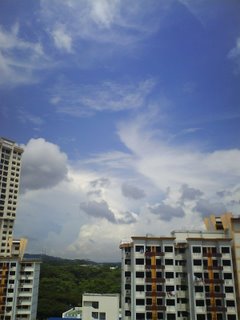
It is probable that this is intended to demonstrate a point about the transience of things, especially weather, which isn't only transient, but capricious as well. Started on EE, approximately 500 words done, or an eighth of the whole thing. Then of course, there's TOK and CAS and History IA and World Lit but that's for another day. A tinge of the holiday malaise, that boredom and lack of purpose, contrasted by stark pictures of clinical classrooms; to the extent that going to school is an exciting departure from the routine. Great weather doesn't help, bad weather makes it worse.
The Scavenger series is not easy to read. It is written not as a formulaic epic fantasy, but a character study, and an exploration on the nature of evil. It is dark, subtle, and almost metaphorical. In the end one realizes that one does not read the Scavenger series for light entertainment, something I must confess was my assumption at first. Still, the books manage to be supremely interesting reading, not the least because of the central mystery of the series - the identity of the main character - is slowly and tortorously revealed over the course of the entire series. It is almost depressing to see how the main character, Poldarn, is forced or manipulated into committing evil and objectionable acts, either for the sake of a greater good, or some strange expediency. And yet, there is this lingering goodness that remains despite the truths of his dark past. In any case, however, I get the feeling that Parker was improvising and retconning things as the story goes on. It is unfortunate that I can't seem to find the other books in the Fencer Trilogy, or the second book of the Engineer trilogy, which is in my opinion much more balanced a story, and actually contains elements of traditional epic fantasy (rather, alternative history) encapsulated within the usual character studies and delicately constructed conspiracies.
Next, Robin Hobb. Then R. Scott Bakker. Then all the texts. I shall buy more books.

It is probable that this is intended to demonstrate a point about the transience of things, especially weather, which isn't only transient, but capricious as well. Started on EE, approximately 500 words done, or an eighth of the whole thing. Then of course, there's TOK and CAS and History IA and World Lit but that's for another day. A tinge of the holiday malaise, that boredom and lack of purpose, contrasted by stark pictures of clinical classrooms; to the extent that going to school is an exciting departure from the routine. Great weather doesn't help, bad weather makes it worse.
The Scavenger series is not easy to read. It is written not as a formulaic epic fantasy, but a character study, and an exploration on the nature of evil. It is dark, subtle, and almost metaphorical. In the end one realizes that one does not read the Scavenger series for light entertainment, something I must confess was my assumption at first. Still, the books manage to be supremely interesting reading, not the least because of the central mystery of the series - the identity of the main character - is slowly and tortorously revealed over the course of the entire series. It is almost depressing to see how the main character, Poldarn, is forced or manipulated into committing evil and objectionable acts, either for the sake of a greater good, or some strange expediency. And yet, there is this lingering goodness that remains despite the truths of his dark past. In any case, however, I get the feeling that Parker was improvising and retconning things as the story goes on. It is unfortunate that I can't seem to find the other books in the Fencer Trilogy, or the second book of the Engineer trilogy, which is in my opinion much more balanced a story, and actually contains elements of traditional epic fantasy (rather, alternative history) encapsulated within the usual character studies and delicately constructed conspiracies.
Next, Robin Hobb. Then R. Scott Bakker. Then all the texts. I shall buy more books.
Monday, November 13, 2006
Books
Over the past few days I've purchased nine books. Of these, four are English A1 texts. The other five include: Shadow and Pattern by K.J. Parker, being the first two novels in her Scavenger trilogy, Ship of Magic by Robin Hobb, being the first book of her Liveship Traders, trilogy, Brave New World by Aldous Huxley, and The Player of Games by Iain M. Banks, a Culture novel. I shall probably purchase more over the holidays. My current list includes:
Memory by K.J. Parker, being the final book in the Scavenger trilogy
Excession by Iain M Banks, a Culture novel
The Mad Ship and Ship of Destiny by Robin Hobb, being the second and third books of Liveship Traders trilogy
Spin by Robert Charles Wilson
The Darkness That Comes Before and The Warrior Prophet by R Scott Bakker, being the first two books of the Prince of Nothing trilogy,
The Lies of Locke Lamora by Scott Lynch (assuming I can locate it)
The Gormenghast Trilogy by Mervyn Peake
Drawing of the Dark by Tim Powers
Lord of Light by Roger Zelazny
I'm impressed with Bank's work. He manages to combine fast-paced action with a compelling picture of an almost utopian society that's very fully realized and intricately detailed. Although the construction of that sort of post-scarcity, machine-governed, fundamentally intellectual-hedonistic society may have been fraught with some difficulties owing to the state of human nature; as it is, humanity's need for material fulfillment is yet one of the primary problems of government and society. Culture society is a vision of libertarianism combined with a sort of lassiez-faire centrally planned economy. It is a bizarre sort of standoff that is not really that explored in the novels; although it probably might be resolved by the fact that the machines, or Minds, can fully anticipate the desires of its populace or, failing that, retains the capacity for rapid construction of the desired commodity for fast gratification in the event that the demand has not been met. Still, waste in a pose-scarcity economy is not a liability. Politically, the Culture is a federated anarchy, where individual habitats retain their own governmental capacity (or such that is necessary for this "perfect" society) while subscribing to a lack of central governmental structure. The problems of anarchy have been resolved in this Culture; factors that lead into chaos in anarchy (such as inability to pool national resources, uncontrolled and unmitigated social ills and violence - which in turn stem from non-access to material wealth - and lack of national purpose) have been excised through the fact that there is no lack of resources, gene engineering has removed undesirable traits from the populace, and that the Culture is bound by no law, which "takes away all incentive to push the limits of what is permissible". Also, although it has no national identity, Culture citizens are bound with a common identity and purpose - as veritable caretakers of a galaxy, and gatherers of knowledge.
Reading Shadow. Interesting but frustrating in its myraid, seemingly unrelated, plotlines. Somehow I sense this is heading for some odd, baroque conclusion. Very formal, dry sort of British wit fills the novel, abit like Susanna Clarke, but less apparent.
Re-read Devices and Desires recently. Refreshingly straightfoward and more lighthearted than Shadow. I look forward to the next book, although it'll be in hardback. Curse these publishers!
Neverwinter Nights 2. Story-driven is good. I've been craving for a good RPG with a stunning, cinematic campaign like the one in Kotor. NWN2 seems to be a good candidate.
Natasha Bedingfield is good.
***
Memory by K.J. Parker, being the final book in the Scavenger trilogy
Excession by Iain M Banks, a Culture novel
The Mad Ship and Ship of Destiny by Robin Hobb, being the second and third books of Liveship Traders trilogy
Spin by Robert Charles Wilson
The Darkness That Comes Before and The Warrior Prophet by R Scott Bakker, being the first two books of the Prince of Nothing trilogy,
The Lies of Locke Lamora by Scott Lynch (assuming I can locate it)
The Gormenghast Trilogy by Mervyn Peake
Drawing of the Dark by Tim Powers
Lord of Light by Roger Zelazny
I'm impressed with Bank's work. He manages to combine fast-paced action with a compelling picture of an almost utopian society that's very fully realized and intricately detailed. Although the construction of that sort of post-scarcity, machine-governed, fundamentally intellectual-hedonistic society may have been fraught with some difficulties owing to the state of human nature; as it is, humanity's need for material fulfillment is yet one of the primary problems of government and society. Culture society is a vision of libertarianism combined with a sort of lassiez-faire centrally planned economy. It is a bizarre sort of standoff that is not really that explored in the novels; although it probably might be resolved by the fact that the machines, or Minds, can fully anticipate the desires of its populace or, failing that, retains the capacity for rapid construction of the desired commodity for fast gratification in the event that the demand has not been met. Still, waste in a pose-scarcity economy is not a liability. Politically, the Culture is a federated anarchy, where individual habitats retain their own governmental capacity (or such that is necessary for this "perfect" society) while subscribing to a lack of central governmental structure. The problems of anarchy have been resolved in this Culture; factors that lead into chaos in anarchy (such as inability to pool national resources, uncontrolled and unmitigated social ills and violence - which in turn stem from non-access to material wealth - and lack of national purpose) have been excised through the fact that there is no lack of resources, gene engineering has removed undesirable traits from the populace, and that the Culture is bound by no law, which "takes away all incentive to push the limits of what is permissible". Also, although it has no national identity, Culture citizens are bound with a common identity and purpose - as veritable caretakers of a galaxy, and gatherers of knowledge.
Reading Shadow. Interesting but frustrating in its myraid, seemingly unrelated, plotlines. Somehow I sense this is heading for some odd, baroque conclusion. Very formal, dry sort of British wit fills the novel, abit like Susanna Clarke, but less apparent.
Re-read Devices and Desires recently. Refreshingly straightfoward and more lighthearted than Shadow. I look forward to the next book, although it'll be in hardback. Curse these publishers!
Neverwinter Nights 2. Story-driven is good. I've been craving for a good RPG with a stunning, cinematic campaign like the one in Kotor. NWN2 seems to be a good candidate.
Natasha Bedingfield is good.
***
Thursday, November 09, 2006
Sea
I am fraught with a kind of distant despair at the sheer number of books out there that are worthy to be read and to possess. It is, however, futile to even consider obtaining even a tiny fraction of these books, yet alone the total corpus of worthies that are the combined output of human genius and hard work.
Still, I am probably going on a large scale procurement of books soon. I shall procure all the English A1 texts, for starters. Then, the Fencer and Scavenger trilogies by KJ Parker, Spin by Robert Charles Wilson, either the Assassins or Liveship Traders trilogies by Robin Hobb, some Iain M Banks novels including The Algebraist, Ken McLeod's Learning the World, Aldous Huxley's Brave New World and Yevgenev Zamyatin's We (EE texts), and a Star Wars novel (Path of Destruction), and then consider the difficulty of finding space on the bookshelf to place all these books. As well as bemoaning the large hole in the pocket. These books should last me three months, enough for the holidays. I might try Drawing of the Dark and the Gormenghast trilogy, based on rave reviews picked up on the Hierophant's blog.
Still, I am probably going on a large scale procurement of books soon. I shall procure all the English A1 texts, for starters. Then, the Fencer and Scavenger trilogies by KJ Parker, Spin by Robert Charles Wilson, either the Assassins or Liveship Traders trilogies by Robin Hobb, some Iain M Banks novels including The Algebraist, Ken McLeod's Learning the World, Aldous Huxley's Brave New World and Yevgenev Zamyatin's We (EE texts), and a Star Wars novel (Path of Destruction), and then consider the difficulty of finding space on the bookshelf to place all these books. As well as bemoaning the large hole in the pocket. These books should last me three months, enough for the holidays. I might try Drawing of the Dark and the Gormenghast trilogy, based on rave reviews picked up on the Hierophant's blog.
Thursday, November 02, 2006
More of the Twain
Once again two months stretch ahead of us. Insert angsty blah about work here.
Okay, we're done with that. Some momentous things have occurred recently. For example, last week I watched The Prestige. I have no time or energy to write a review, especially when the prudent reviewer must needs deftly avoid the subject of the (shockingly) convoluted plot while interspersing pithy insights about how it contributes to the artistic development of the film industry at large, and by logical extension, director Chris Nolan's pants pocket. Let us perhaps, say that it gets rather (shockingly) repetitive at times. Still, there are some odd features of the technical periphanalia that remind one of Xerox and horns overflowing with lush fruit. Still, I would advise you to look closely at Christian Bale's fingers.
I have recently been obsessed with fantasy fiction. Rather, I have been overwhelmed by a deluge of fantasy. First, A Feast for Crows, by George RR Martin. Following We, which is more science fiction in the sff continuum, The Simoqin Prophecies and its successor The Manticore's Secret, by Samit Basu, lent to me by Nova in bitter revenge over my similar act of insidious manipulation, i.e., the seemingly magmanimous lending of A Game of Thrones, a riveting tale that has left him unable to perform tasks that require both hands for a week, which is, in any case, followed by at least 7 more.
Nova will perhaps write about it. The Simoqin Prophecies is written by an Indian and is rather novel (no pun intended). It's written like a traditional fantasy novel a la Terry Brooks and then given a shocking twist. It draws from Greek and Indian mythology and is written in a very tongue in cheek fashion, similar to Pratchett's Discworld. Except this is the GameWorld, the origin of which is not a subject until the second book. The book features two fascinating names: Narak and Kirin. Hm.
I have been thinking of Star Wars. I believe it is an artistic experiment, a treatment on the Campbellian hero-legend in a sci-fi, pop-culture universe. It is an indie film that never lost its indieness, which is still indie, except the company that produced it is a large corporation now, and makes indie films that are no longer as indie, but perhaps indie because stylistically it incurs the wrath of Luddite fans who prefer 'ol' bucket o' bolts', like, "what the hell is an aluminium falcon?" or perhaps neo-Victorian love dialogue is not to their taste. So it is indie and affected by other indies who, by the very act of observation, are destroying the indieness of the movie by demanding the good ol' days where they, as tiny children, played with Slave I toys. But maybe the indies affect indies by increasing the indieness of the said indie, because they are already indie, ergo, they have the right to determine the indieness of the movie, unlike the unwashed peasants that are the masses. No literati will touch that which is already soiled by the lips of the Untermensch that are the amateur. Thus, Star Wars comports itself badly. So does Lord of the Rings. I mean, who reads Pepys nowadays.
Rain threatens to consume the earth. Normally I despise rain but evenings are particularly nice for a heavy storm. Unless you're like, outside.
Wee Shu Min. Undoubtedly she has been misquoted by the press and has been put under mind control by the secret paparrazi organization known as the Flashy Four Hundred. She now lives an ascetic lifestyle and is served by short bald men called Abhishek, summoned now and then to declare statements of apology from her underground bunker-house. Ok. Obligatory mention of significant event over the vast thing that is the Web.
More later.
***
Okay, we're done with that. Some momentous things have occurred recently. For example, last week I watched The Prestige. I have no time or energy to write a review, especially when the prudent reviewer must needs deftly avoid the subject of the (shockingly) convoluted plot while interspersing pithy insights about how it contributes to the artistic development of the film industry at large, and by logical extension, director Chris Nolan's pants pocket. Let us perhaps, say that it gets rather (shockingly) repetitive at times. Still, there are some odd features of the technical periphanalia that remind one of Xerox and horns overflowing with lush fruit. Still, I would advise you to look closely at Christian Bale's fingers.
I have recently been obsessed with fantasy fiction. Rather, I have been overwhelmed by a deluge of fantasy. First, A Feast for Crows, by George RR Martin. Following We, which is more science fiction in the sff continuum, The Simoqin Prophecies and its successor The Manticore's Secret, by Samit Basu, lent to me by Nova in bitter revenge over my similar act of insidious manipulation, i.e., the seemingly magmanimous lending of A Game of Thrones, a riveting tale that has left him unable to perform tasks that require both hands for a week, which is, in any case, followed by at least 7 more.
Nova will perhaps write about it. The Simoqin Prophecies is written by an Indian and is rather novel (no pun intended). It's written like a traditional fantasy novel a la Terry Brooks and then given a shocking twist. It draws from Greek and Indian mythology and is written in a very tongue in cheek fashion, similar to Pratchett's Discworld. Except this is the GameWorld, the origin of which is not a subject until the second book. The book features two fascinating names: Narak and Kirin. Hm.
I have been thinking of Star Wars. I believe it is an artistic experiment, a treatment on the Campbellian hero-legend in a sci-fi, pop-culture universe. It is an indie film that never lost its indieness, which is still indie, except the company that produced it is a large corporation now, and makes indie films that are no longer as indie, but perhaps indie because stylistically it incurs the wrath of Luddite fans who prefer 'ol' bucket o' bolts', like, "what the hell is an aluminium falcon?" or perhaps neo-Victorian love dialogue is not to their taste. So it is indie and affected by other indies who, by the very act of observation, are destroying the indieness of the movie by demanding the good ol' days where they, as tiny children, played with Slave I toys. But maybe the indies affect indies by increasing the indieness of the said indie, because they are already indie, ergo, they have the right to determine the indieness of the movie, unlike the unwashed peasants that are the masses. No literati will touch that which is already soiled by the lips of the Untermensch that are the amateur. Thus, Star Wars comports itself badly. So does Lord of the Rings. I mean, who reads Pepys nowadays.
Rain threatens to consume the earth. Normally I despise rain but evenings are particularly nice for a heavy storm. Unless you're like, outside.
Wee Shu Min. Undoubtedly she has been misquoted by the press and has been put under mind control by the secret paparrazi organization known as the Flashy Four Hundred. She now lives an ascetic lifestyle and is served by short bald men called Abhishek, summoned now and then to declare statements of apology from her underground bunker-house. Ok. Obligatory mention of significant event over the vast thing that is the Web.
More later.
***
Thursday, October 19, 2006
Leaves
The rain had stopped; the embers had long since faded from angry red to black, when she at last dared step out of her hole. The reavers had long since gone, having taken their share of plunder and savage pleasure. Men and women they had carried off for chattel. Bodies of the old and infirm lay scattered about the burning remnants. Children...they had butchered children, ridden them down in the heat of bloodlust, scattered them and hunted them like they would hunt rabbits. Of course, they had taken them as well.
But her, of course.
She did not remember her father's face. How he had held on to the table as he was dragged inexorably away. His haunted eyes on hers. Rememberance was denial. Rememberance was fatal. She knew in her child's heart, unconsciously, perhaps, that hatred was a winding stair that led her into the fires of Grend. Her father should know. Her father. Who was her father? Only now did it dawn on her to ask. Who had he been? Once she played games with other children, an eternity ago. One particular game, "Hero or Brigand", stood out in her mind now. She had always wondered why the two should be mutually exclusive. Was her father a hero or a brigand? Or both? Grend take your questions, he would say. She could hear him in her mind's ear. Grend was the mage of the netherworld, antithesis of Val, the mountain god. She always wanted why Grend would want her questions, or why he would somehow know all the answers.
She walked among the dead. Ravens cawed and fought for their bounty. The burnt home rose in front of her. The tree still stood, though. Somehow she didn't think anything in the town still stood, it was so ugly and grey and incomplete. There were even apples on the tree. Red apples that stood out against the noir landscape. Red on grey silt and dust. The dust of the dead. She plucked one and bit into it. It was red and juicy and it made her teeth hurt, but it was good, she was so hungry.
When she had finished, the apple core fluttered from her hand. It flew around and settled on the grass like a king. A King with a crown of stalk and dust, and courtiers of dried leaves. How redolent it was, sitting there among the grey grass, pridefully dominating. How the leaves bowed to their newfound sovreign. How they crinkled up with fear and awe. She ate an apple and it became the King of Leaves. She remembered the story of Daer the Kingmaker, who made four kings and outlived them all. What is made can be unmade. That was how that tale was concluded. What is done can never be undone. Her father would never sit by the fire with her again.
She kicked the apple core away. Soon, she knew, it would turn brown and fade and maggots would crawl on it and devour what meat she had not eaten. I shared my apple with worms. I made my King and worms shall unmake him, and eat his noble mien. The apple rolled and stopped. The tree and the garden and the little house, where are they? They are here. The tree is here, the house and the garden. The green bushes that sparkled with sunlight on a spring morning, the grass that swayed with the autumn wind. The apples that would rustle the leaves, the deep and verdant green summer leaves, where are they now? Did the reavers take them too? Or did her father? Did father take them with him when they took him away? The chair at the back, that he had been working on. It was still there. Incomplete. The chair will never finish. Never never ever. What is made cannot be unmade. Not even kings.
She looked at the apple. Not even memories, she thought.
She could feel the tree talking to her. What is done can be undone, what is made cannot be unmade. Thank you, she told him. Then, turning, she left the house, left the apple, and the garden, and picked up a fallen dagger and a sack and walked into the sunset.
***
But her, of course.
She did not remember her father's face. How he had held on to the table as he was dragged inexorably away. His haunted eyes on hers. Rememberance was denial. Rememberance was fatal. She knew in her child's heart, unconsciously, perhaps, that hatred was a winding stair that led her into the fires of Grend. Her father should know. Her father. Who was her father? Only now did it dawn on her to ask. Who had he been? Once she played games with other children, an eternity ago. One particular game, "Hero or Brigand", stood out in her mind now. She had always wondered why the two should be mutually exclusive. Was her father a hero or a brigand? Or both? Grend take your questions, he would say. She could hear him in her mind's ear. Grend was the mage of the netherworld, antithesis of Val, the mountain god. She always wanted why Grend would want her questions, or why he would somehow know all the answers.
She walked among the dead. Ravens cawed and fought for their bounty. The burnt home rose in front of her. The tree still stood, though. Somehow she didn't think anything in the town still stood, it was so ugly and grey and incomplete. There were even apples on the tree. Red apples that stood out against the noir landscape. Red on grey silt and dust. The dust of the dead. She plucked one and bit into it. It was red and juicy and it made her teeth hurt, but it was good, she was so hungry.
When she had finished, the apple core fluttered from her hand. It flew around and settled on the grass like a king. A King with a crown of stalk and dust, and courtiers of dried leaves. How redolent it was, sitting there among the grey grass, pridefully dominating. How the leaves bowed to their newfound sovreign. How they crinkled up with fear and awe. She ate an apple and it became the King of Leaves. She remembered the story of Daer the Kingmaker, who made four kings and outlived them all. What is made can be unmade. That was how that tale was concluded. What is done can never be undone. Her father would never sit by the fire with her again.
She kicked the apple core away. Soon, she knew, it would turn brown and fade and maggots would crawl on it and devour what meat she had not eaten. I shared my apple with worms. I made my King and worms shall unmake him, and eat his noble mien. The apple rolled and stopped. The tree and the garden and the little house, where are they? They are here. The tree is here, the house and the garden. The green bushes that sparkled with sunlight on a spring morning, the grass that swayed with the autumn wind. The apples that would rustle the leaves, the deep and verdant green summer leaves, where are they now? Did the reavers take them too? Or did her father? Did father take them with him when they took him away? The chair at the back, that he had been working on. It was still there. Incomplete. The chair will never finish. Never never ever. What is made cannot be unmade. Not even kings.
She looked at the apple. Not even memories, she thought.
She could feel the tree talking to her. What is done can be undone, what is made cannot be unmade. Thank you, she told him. Then, turning, she left the house, left the apple, and the garden, and picked up a fallen dagger and a sack and walked into the sunset.
***
Friday, September 29, 2006
A Primer
This is a cautionary post of the tides of time. Tension is backwards relavistic; it radiates backwards in time from the perceived source of the tension-causing event and is thusly assimilated into the unwary and hapless observer far back in the temporal stream. Some are more sensitive receivers than others. The quantitative scale of this receptivity to tension is known as "worrisomeness"; however, the ICS (Internal Common Standard) classifies it as "paranoia". Other, less reputable scales call it "obsessiveness", yet others classify it as a distant derivant of "work ethic". All generally agree on the accepted SI derivation of this measure. It is kgm^2s^-3, which is to say, work done over time. It is inversely proportional with distance to the source of tension. This is known as the Law of Frantic Revision. Unfortunately, it only applies to Ideal Students, because it makes several assumptions about the condition of the experimental medium, for example, that no intersocial forces exist between Ideal Students, or that his capacity to slack is negligible. But there is, then, no such thing as an Ideal Student. The effects of the non-ideal behaviour of some students may be remedied by 1. Increasing the pressure, and 2. Decreasing the heat.
***
The sheer banality of the forthcoming exhortation: The Exams Are Coming! Banal or blase? It is a thing of great debate. For are exams ever mundane? Or are they like a cheese grater? Or worse yet, a great cheese? Exams are necessary. Unpleasant, but the essence of exams go beyond that of testing one's concepts; they are engineered to pressure the growing student, to test his or her diligence, preserverance and time management. The post-exam time will bring with it fruit of plenty, and burdens anew. But on the whole I look forward to the time I can play Civ IV and read up on transhumanism. But now we can only plod on, ever stoic.
***
***
The sheer banality of the forthcoming exhortation: The Exams Are Coming! Banal or blase? It is a thing of great debate. For are exams ever mundane? Or are they like a cheese grater? Or worse yet, a great cheese? Exams are necessary. Unpleasant, but the essence of exams go beyond that of testing one's concepts; they are engineered to pressure the growing student, to test his or her diligence, preserverance and time management. The post-exam time will bring with it fruit of plenty, and burdens anew. But on the whole I look forward to the time I can play Civ IV and read up on transhumanism. But now we can only plod on, ever stoic.
***
Friday, September 15, 2006
The Screamer
Ai. Once there was the Ardent
That once sailed the warm currents
Of the sea. Thousands did it plunder
With gun and leatherbound whip
And the great dog-pirate like steelclad thunder
Did spear the most with his swordtip.
Then there came one terror-dusk
Of raging sea. Storms did take the lives of men
Scurvy-ridden hounds. They cast the ballast
Into the hungry waters, gave their rum to the questing sea
And the Ardent ardently did pray for the mien
Of the sun mordant to be.
But it was of little avail, you see
For the Ardent did sink'st into the sea.
And men and dogs did give their lives
to She. A thousand chests of plunder
Were the payment for her savage fee.
But no sea-dog was he,
Great Dog-Pirate with the iron knee.
He shook his cutlass free and leapt into stormy sea.
Torrential maw consumed him not
That savage spirit
And found a plank did he, with his iron claw
He hooked the rotting wood to his body
And floated away with the debri.
And survived in the raging seas did he
Great Dog-Pirate
And he snarled portents of defiance
To the capricious fates of storm that came to be
Dogs howled in his commiseration
And agonizingly
His shouts were heard throughout the lands around the sea
His hollers herald the night to be.
And quaking landsmen did cower anxiously
At the echoing calls of the Great Dog-Pirate
He of the steel claw and iron knee.
And in the dusk when the night is clear to see,
Huddle in taverns and whisper mysteriously
Of the deep chants and savage howls of he
He, who they name the "Snarler of the Sargasso",
The Screamer of the Sea.
That once sailed the warm currents
Of the sea. Thousands did it plunder
With gun and leatherbound whip
And the great dog-pirate like steelclad thunder
Did spear the most with his swordtip.
Then there came one terror-dusk
Of raging sea. Storms did take the lives of men
Scurvy-ridden hounds. They cast the ballast
Into the hungry waters, gave their rum to the questing sea
And the Ardent ardently did pray for the mien
Of the sun mordant to be.
But it was of little avail, you see
For the Ardent did sink'st into the sea.
And men and dogs did give their lives
to She. A thousand chests of plunder
Were the payment for her savage fee.
But no sea-dog was he,
Great Dog-Pirate with the iron knee.
He shook his cutlass free and leapt into stormy sea.
Torrential maw consumed him not
That savage spirit
And found a plank did he, with his iron claw
He hooked the rotting wood to his body
And floated away with the debri.
And survived in the raging seas did he
Great Dog-Pirate
And he snarled portents of defiance
To the capricious fates of storm that came to be
Dogs howled in his commiseration
And agonizingly
His shouts were heard throughout the lands around the sea
His hollers herald the night to be.
And quaking landsmen did cower anxiously
At the echoing calls of the Great Dog-Pirate
He of the steel claw and iron knee.
And in the dusk when the night is clear to see,
Huddle in taverns and whisper mysteriously
Of the deep chants and savage howls of he
He, who they name the "Snarler of the Sargasso",
The Screamer of the Sea.
Thursday, September 14, 2006
Nursery Nonsense
The Pied Piper of Paris
had never heard of a ferry,
For when he led the mice
away from the rice
He joined them under the sea
had never heard of a ferry,
For when he led the mice
away from the rice
He joined them under the sea
Monday, September 11, 2006
Musings
These days I feel dry of thought, but the show must go on; blogs must be updated, guns must be shot, and IMF meetings must be allowed to begin in earnest. There will be no cessation of terrors if this blog is allowed to stagnate.
So, I do blog. But it is fortunate that there are issues to talk about. For instance, the IMF/World Bank Meetings. I, for one, must agree with the Singapore Government's ban on outdoor protests. This has nothing to do with the legality or freedom of expression - that issue is moot in this light. But it is true that the Government cannot afford to play double standards towards its populace, either it abolishes the ban for good, which will never happen as long as the PAP rules over this nation (or probably not), or it does nothing and stands firm by the order and, perhaps, restrictiveness that has become a part of the rule of law in this here and now. And there are of course several safety issues that must be observed, for both the would-be demonstrators and the IMF delegates. But its a shame, really, for our image - this is amounting to an image disaster for Singapore, and all the careful preparations - the flowers, the Smiles campaign, the Biennale, are going to seem rather flat when taken in the same dose as the restrictions. I wonder what the delegates think.
***
School rules. I must applaud the disciplinary measures the Student Council is taking, especially with regards to truancy. It's been an enduring and distressing issue that is plaguing the school - this wanton, casual, wilful skipping of classes and leaving school early. Draconian measures should be taken, and they have been. Notwithstanding Alistairs demented briefing the Council's measures are a good step forward. However, the ban on cards is another thing entirely. It, simply put, is nonsensical in premise and I am quite sure it will not be enforced. I've seen councilors playing bridge; cardplaying is a harmless activity as long as it doesnt involve an exchange of banknotes I don't see why it should be considered a violation of the school rules to play it as a purely recreational activity. You can gamble with anything, not just cards - you could bet on soccer matches, board games, and coin tossing, but that doesnt mean we can ban all those things. The rationale for the banning of playing cards is bunk. Better to join the mass of card players than hope to quash the tradition. And I don't even know how to play.
***
I have finished reading Olympos, the sequel to Ilium, and while most of the book was wonderful, the end left me in the dark as to what actually took place. Plot threads have been resolved in strange fashions and Simmons likes to leave some threads hanging. It is perhaps pertinent to re-read it as a future juncture to ascertain what Simmons was writing about. The inclusion of myraid literary elements, including Keats, Homer, Proust and Shakespeare were exceedingly novel, especially when deliciously juxtaposed against the modern-day musings of one of the protagonists, Thomas Hockenberry, a Twentieth century Iliad academic who has been revived by far-future Gods to catalogue their reenactment of the Trojan war as reported by Homer in Iliad. What else is interesting is that Simmons has chosen to make one of his non-human characters the most enduringly human of all the characters; Mahnmut, the moravec. That character is handled with great deftness and care, emphasizing one of the themes of the novel - the power of creative genius to inspire only those who truly understand the essence of humanity. Simmons places great store on the creative genius, reinterpreting it in a science-fiction sense, that it has the sheer power to create metaphorical universes of beauty and complexity. But you have to read it to understand it.
***
So, I do blog. But it is fortunate that there are issues to talk about. For instance, the IMF/World Bank Meetings. I, for one, must agree with the Singapore Government's ban on outdoor protests. This has nothing to do with the legality or freedom of expression - that issue is moot in this light. But it is true that the Government cannot afford to play double standards towards its populace, either it abolishes the ban for good, which will never happen as long as the PAP rules over this nation (or probably not), or it does nothing and stands firm by the order and, perhaps, restrictiveness that has become a part of the rule of law in this here and now. And there are of course several safety issues that must be observed, for both the would-be demonstrators and the IMF delegates. But its a shame, really, for our image - this is amounting to an image disaster for Singapore, and all the careful preparations - the flowers, the Smiles campaign, the Biennale, are going to seem rather flat when taken in the same dose as the restrictions. I wonder what the delegates think.
***
School rules. I must applaud the disciplinary measures the Student Council is taking, especially with regards to truancy. It's been an enduring and distressing issue that is plaguing the school - this wanton, casual, wilful skipping of classes and leaving school early. Draconian measures should be taken, and they have been. Notwithstanding Alistairs demented briefing the Council's measures are a good step forward. However, the ban on cards is another thing entirely. It, simply put, is nonsensical in premise and I am quite sure it will not be enforced. I've seen councilors playing bridge; cardplaying is a harmless activity as long as it doesnt involve an exchange of banknotes I don't see why it should be considered a violation of the school rules to play it as a purely recreational activity. You can gamble with anything, not just cards - you could bet on soccer matches, board games, and coin tossing, but that doesnt mean we can ban all those things. The rationale for the banning of playing cards is bunk. Better to join the mass of card players than hope to quash the tradition. And I don't even know how to play.
***
I have finished reading Olympos, the sequel to Ilium, and while most of the book was wonderful, the end left me in the dark as to what actually took place. Plot threads have been resolved in strange fashions and Simmons likes to leave some threads hanging. It is perhaps pertinent to re-read it as a future juncture to ascertain what Simmons was writing about. The inclusion of myraid literary elements, including Keats, Homer, Proust and Shakespeare were exceedingly novel, especially when deliciously juxtaposed against the modern-day musings of one of the protagonists, Thomas Hockenberry, a Twentieth century Iliad academic who has been revived by far-future Gods to catalogue their reenactment of the Trojan war as reported by Homer in Iliad. What else is interesting is that Simmons has chosen to make one of his non-human characters the most enduringly human of all the characters; Mahnmut, the moravec. That character is handled with great deftness and care, emphasizing one of the themes of the novel - the power of creative genius to inspire only those who truly understand the essence of humanity. Simmons places great store on the creative genius, reinterpreting it in a science-fiction sense, that it has the sheer power to create metaphorical universes of beauty and complexity. But you have to read it to understand it.
***
Monday, August 28, 2006
Snow
I have always had a vicarious love-affair with snow, even before my fingers had ever brushed it, or crushed it into soft balls, or handled great crystalline blocks of it to fling over the distance. Funny, how snow, present everywhere in every form, pervasive in the very air around us; that unattainable and precious crystalline form of life-giving water; funny how it never comes to us but in the coldest of climes; and then, when the perfect moment comes, all drift down in mighty cascades of white gold that collapse power lines and turn automobiles into silent mounds of icing-laid cake.
Here in Singapore one wonders how the Northerners in their think parkas must feel, freezing in their little log-cabins, crouching around a fire crackling merry warmth. And yet the cold is its own magic, the silence broken only by wind and the little gusts of white swriling around the conifers. I always imagine the breathy whisper of branches and the almost-silent drift of floating flakes. The feeling of dusk at winter and the deepening blue lit, perhaps, by shimmering carpets of the Aurora Borealis at latitudes far removed from here, dancing life's joy, celebrating the misty snowy night. At times I think of a snowtopped mountain amidst a mighty cluster of peaks, snowcapped and covered in pristine perfect snow; every footstep an ecstasy, a perfectly crafted print that marrs the smooth surface of the white, fine snow that crumbles like sand in gloved fingers, cyan cloudless sky and sun above, craggy peak and blinding snow below, or a vast canvas of starry night that enshrouds the sleeping world in soft night's chime.
I have felt snow, handled it. It was a novel and wonderful experience. It is almost what I experienced in my daydreams, albeit real snow is rather colder and icier than I would like. In towns, much of it is dirty. But pristine snow on mountains, brilliant blue sky dividing the world in two, white and blue. Now, that was postcard perfect in my dreams. Too bad I have a predilection for altitude sickness.
Those who live among snow must feel the strain of cold, must be tired of gazing at the mountains, perhaps wishing for a warmer clime, among palm fronds and iced cocktails and sandy beaches. I love palm trees and coconut trees; they seem exotic to me, and, like elm and maple, are living art, sculptures that grow, statues that change. But I, too yearn for winter and cold, for snow and blue sky and chilling wind and mountain air.
It is an escapist fantasy perhaps, but nonetheless it speaks to me in my mind, dances with my dreams, beckons to me with the promise of the blue skies, that empyrean ocean of wonder.
***
Here in Singapore one wonders how the Northerners in their think parkas must feel, freezing in their little log-cabins, crouching around a fire crackling merry warmth. And yet the cold is its own magic, the silence broken only by wind and the little gusts of white swriling around the conifers. I always imagine the breathy whisper of branches and the almost-silent drift of floating flakes. The feeling of dusk at winter and the deepening blue lit, perhaps, by shimmering carpets of the Aurora Borealis at latitudes far removed from here, dancing life's joy, celebrating the misty snowy night. At times I think of a snowtopped mountain amidst a mighty cluster of peaks, snowcapped and covered in pristine perfect snow; every footstep an ecstasy, a perfectly crafted print that marrs the smooth surface of the white, fine snow that crumbles like sand in gloved fingers, cyan cloudless sky and sun above, craggy peak and blinding snow below, or a vast canvas of starry night that enshrouds the sleeping world in soft night's chime.
I have felt snow, handled it. It was a novel and wonderful experience. It is almost what I experienced in my daydreams, albeit real snow is rather colder and icier than I would like. In towns, much of it is dirty. But pristine snow on mountains, brilliant blue sky dividing the world in two, white and blue. Now, that was postcard perfect in my dreams. Too bad I have a predilection for altitude sickness.
Those who live among snow must feel the strain of cold, must be tired of gazing at the mountains, perhaps wishing for a warmer clime, among palm fronds and iced cocktails and sandy beaches. I love palm trees and coconut trees; they seem exotic to me, and, like elm and maple, are living art, sculptures that grow, statues that change. But I, too yearn for winter and cold, for snow and blue sky and chilling wind and mountain air.
It is an escapist fantasy perhaps, but nonetheless it speaks to me in my mind, dances with my dreams, beckons to me with the promise of the blue skies, that empyrean ocean of wonder.
***
Wednesday, August 16, 2006
Inbound
The passenger liner hurtled on through the faux-blue realm of hyperspace, bound inexorable for the centre of the universe. Within its cavernous interior thousands of immigrants, returning citizens, and transit passengers sat and mingled and ate and slept - or did the equivalent of their species - the normal hubbub of sapient activity so native to the galaxy at large.
Genes did not unite the Galaxy, but shared communion of life did.
This was not the era of war and strife, of conflicts that consumed worlds. The Sith Wars had died out years ago; the Sith in hiding or dead, never having risen again. The galaxy was in the throes of its last golden age under the Republic. Trade lanes lay open under the token protection of the Republic Navy. Ships in the trillions navigated the space lanes, feeding the ever-growing furnace of the Galactic economy. At once there was a demographic shift to the more affluent Core Worlds. Planets of renown and legend, names that whispered down the corridors of galactic history - Corellia, Corulag, Alderaan - now found themselves targets of eager floods of suddenly-affluent galactic migrants inbound from less glamorous locales in the outer reaches of the galaxy.
For what seemed the first time in thousands of years of strife, those planets had the resources to accomodate the swarming crowds.
The Centre of the Universe, ironically, had never enjoyed such control. Coruscant, embattled ecumenupolis, bearer of a thousand scars of conflict - motherworld of civilization - it has always been the figurehead of a galaxy that took care of itself. Privy to the wishes of smaller, more powerful conglomerates, like the Czerka corporation or the Huttese economic and political hegemony, Coruscant was bound to play a continuous cosmic game of chance and political appeasement to these myraid groupings. It was little more than a nominal leader to the Core Worlds and not much more than a distant guardian of the Outer Rim, where the Republic was little more than a distant rumour and corporations ruled with absolute control.
With the end of the Sith Wars, however, all that changed. A century of increasing Republic control and propaganda established the political and economic supremacy of the Republic. Draconian trade laws enforced by a heavy hand massively reduced the clout of the hegemonies plaguing the worlds of the Rim. The Republic became synonymous with a force for civilization, hearkening back to the days of the Unification Wars where the Republic brought the fruits of technology to all it encountered.
The Republic became the great civilizing force, the bringer of light, the bastion of progress and freedom. And this brought with it greater control than ever before, with outbound planets supporting the Republic which had freed hem from the clutches of exploitative galactic companies like Czerka.
No longer would a foe find the Republic unprepared for war. Space was a perpetual conflict zone, and the Republic Navy controlled everything. Even the enemy had to use space lanes that had been scouted out. Space lanes could come under the interdict. No foe would ever hope to penetrate the trade lanes that led to the Core.
But this centralization, this peace, would not last. Already it was showing signs of instability. As the disapora continued, balance must be restored. The inbound would come, but along with it, the Mid Rim would sag into obscurity. Lacking its administrators and businessmen and scientists, planets would stagnate. As the diaspora continued, the Core Worlds would also sag under the weight of the immigration of billions. Immigration laws made little sense in the context of entire worlds - it was easy to disappear into planets. Especially planets like Coruscant or Humbarine. The vicious cycle would continue until the Republic would sag under the weight of centralization and stagnation. The bureaucracy would inflate, coorporations would reestablish their footing on distant planets. Power blocs would form, with senators defending the interests of their sectors.
Balance.
Where there are peaks, there are also valleys.
One would come, of an ancient prophecy, he who will bring balance.
The inbound ship hurtled on in hyperspace, carrying the seeds of chaos. To Coruscant it would come.
***
Genes did not unite the Galaxy, but shared communion of life did.
This was not the era of war and strife, of conflicts that consumed worlds. The Sith Wars had died out years ago; the Sith in hiding or dead, never having risen again. The galaxy was in the throes of its last golden age under the Republic. Trade lanes lay open under the token protection of the Republic Navy. Ships in the trillions navigated the space lanes, feeding the ever-growing furnace of the Galactic economy. At once there was a demographic shift to the more affluent Core Worlds. Planets of renown and legend, names that whispered down the corridors of galactic history - Corellia, Corulag, Alderaan - now found themselves targets of eager floods of suddenly-affluent galactic migrants inbound from less glamorous locales in the outer reaches of the galaxy.
For what seemed the first time in thousands of years of strife, those planets had the resources to accomodate the swarming crowds.
The Centre of the Universe, ironically, had never enjoyed such control. Coruscant, embattled ecumenupolis, bearer of a thousand scars of conflict - motherworld of civilization - it has always been the figurehead of a galaxy that took care of itself. Privy to the wishes of smaller, more powerful conglomerates, like the Czerka corporation or the Huttese economic and political hegemony, Coruscant was bound to play a continuous cosmic game of chance and political appeasement to these myraid groupings. It was little more than a nominal leader to the Core Worlds and not much more than a distant guardian of the Outer Rim, where the Republic was little more than a distant rumour and corporations ruled with absolute control.
With the end of the Sith Wars, however, all that changed. A century of increasing Republic control and propaganda established the political and economic supremacy of the Republic. Draconian trade laws enforced by a heavy hand massively reduced the clout of the hegemonies plaguing the worlds of the Rim. The Republic became synonymous with a force for civilization, hearkening back to the days of the Unification Wars where the Republic brought the fruits of technology to all it encountered.
The Republic became the great civilizing force, the bringer of light, the bastion of progress and freedom. And this brought with it greater control than ever before, with outbound planets supporting the Republic which had freed hem from the clutches of exploitative galactic companies like Czerka.
No longer would a foe find the Republic unprepared for war. Space was a perpetual conflict zone, and the Republic Navy controlled everything. Even the enemy had to use space lanes that had been scouted out. Space lanes could come under the interdict. No foe would ever hope to penetrate the trade lanes that led to the Core.
But this centralization, this peace, would not last. Already it was showing signs of instability. As the disapora continued, balance must be restored. The inbound would come, but along with it, the Mid Rim would sag into obscurity. Lacking its administrators and businessmen and scientists, planets would stagnate. As the diaspora continued, the Core Worlds would also sag under the weight of the immigration of billions. Immigration laws made little sense in the context of entire worlds - it was easy to disappear into planets. Especially planets like Coruscant or Humbarine. The vicious cycle would continue until the Republic would sag under the weight of centralization and stagnation. The bureaucracy would inflate, coorporations would reestablish their footing on distant planets. Power blocs would form, with senators defending the interests of their sectors.
Balance.
Where there are peaks, there are also valleys.
One would come, of an ancient prophecy, he who will bring balance.
The inbound ship hurtled on in hyperspace, carrying the seeds of chaos. To Coruscant it would come.
***
Saturday, August 12, 2006
Equatorial Night Lights
Yesterday I had the fortune to be able to witness (from a reasonably clear vantage point, to boot) the New Caledonia fireworks display for the SFF.
Truly a spectacle, I should say, more so because I don't think I've ever seen fireworks up close before, feeling the urban crush of others around, the mass of people congregating to see and to be excited, the deep reverberations shivering up my legs as cannonade after cannonade of gunpowder-packed fireworks were projected up into the sky to burst in a myraid of coloured streamers of fiery light. There were the usual skybursts of red and golden, and those with two or many colours. There were shimmering cascades of molten frisbees spinning out into the night. There were golden showers of sparkling waterfalls and cunningly aimed explosions that seemed bent on roaring towards us before being consumed by the darkness. There were red ones that burst, and the showers that they released burst once more, creating chain reactions of crimson rain. Smoke obscured good photographs and highlighted others, and deep red shone off their cavernous plumes, and long trails, reminiscent of crashing aeroplanes or crop-dusting aircraft, spun off in many directions. The spectators were kept, enthralled, for ten short minutes as bursts of fireworks ascended in majestic beauty. After that, of course, it was all chaos.
***
The morn still bleeds tears of mist for the revelry of the past night.
Truly a spectacle, I should say, more so because I don't think I've ever seen fireworks up close before, feeling the urban crush of others around, the mass of people congregating to see and to be excited, the deep reverberations shivering up my legs as cannonade after cannonade of gunpowder-packed fireworks were projected up into the sky to burst in a myraid of coloured streamers of fiery light. There were the usual skybursts of red and golden, and those with two or many colours. There were shimmering cascades of molten frisbees spinning out into the night. There were golden showers of sparkling waterfalls and cunningly aimed explosions that seemed bent on roaring towards us before being consumed by the darkness. There were red ones that burst, and the showers that they released burst once more, creating chain reactions of crimson rain. Smoke obscured good photographs and highlighted others, and deep red shone off their cavernous plumes, and long trails, reminiscent of crashing aeroplanes or crop-dusting aircraft, spun off in many directions. The spectators were kept, enthralled, for ten short minutes as bursts of fireworks ascended in majestic beauty. After that, of course, it was all chaos.
***
The morn still bleeds tears of mist for the revelry of the past night.
Subscribe to:
Posts (Atom)

